Rare fruit revolution: Cyrus Roussilhes’ Perth garden
2026-08-20T15:30:47+10:00
Cyrus Roussilhes, a rare fruit grower from Perth, is on a mission to inspire gardeners to grow unusual varieties in their own backyard, writes Deryn Thorpe.
Common supermarket fruits have a limited attraction for Cyrus Roussilhes, who craves the unusual and started growing uncommon edibles on his 700m² suburban block 16 years ago. His curiosity has developed into a consuming passion and a fruiting paradise with 750 different edible plants growing in his backyard nursery. Cyrus’ gardening journey started with aquaponics, raising black bream and cycling water through beds planted with fruit trees, herbs and vegies. He became hooked and within 18 months had replaced all his lawn with fruit trees. At the start, Perth’s sandy soils and hot, dry summers were challenging but after much research Cyrus realised the answer was imitating nature. “I follow a regenerative agriculture method, developed from permaculture and agroforestry, that creates highly productive, self-sustaining ecosystems by mimicking natural forest succession and layered plantings,” he says.
A shady jungle
The garden at the front of his home gives little hint of the jungle beyond that’s covered in plants from the ground to the sky. Narrow paths wind through the dense undergrowth with small and medium pots on the ground. The bigger shrubs and trees are planted in the soil to provide the shade needed in Perth’s hot summers. His plantings mimic a rainforest and trap humidity, needing less water because shade and moisture reduce temperatures by more than 15°C. Cyrus waters deeply in the evening so the moisture soaks in overnight and this trains the roots to seek water in the cooler subsoil. Plants are fed with compost, and prunings are chopped up and left on the soil as a mulch, which creates a protective soil blanket.
Cooling techniques
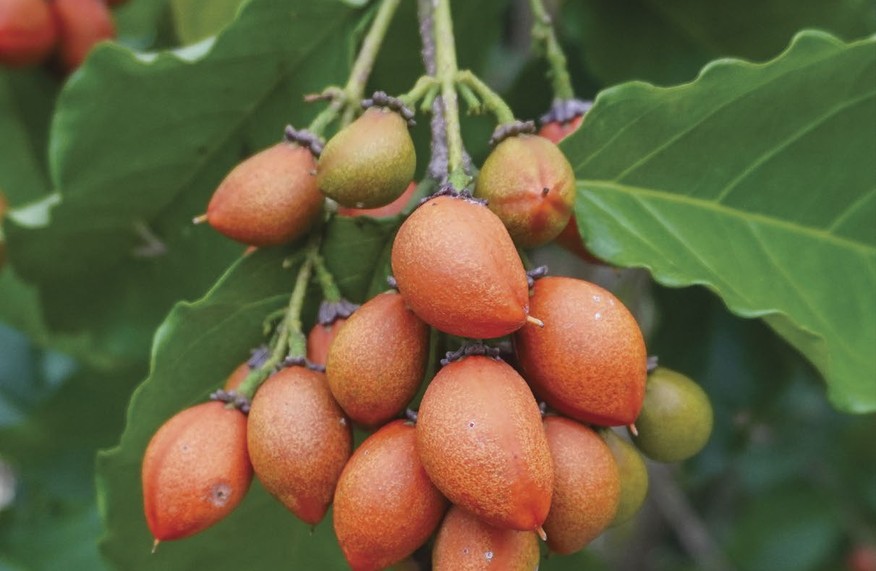
“Perth soils are naturally water repellent so I throw down leaves from the native soap tree (Alphitonia excelsa) as they reduce hydrophobic soil by releasing natural saponins (soaps) when they get wet; these break the surface tension of the water so it can penetrate into waxy, dry sand instead of just running off the top.” Other cooling techniques include painting tree trunks with diluted, white, water-based paint to reflect the sun, which prevents the bark from splitting and the sap from boiling on 40°C days. “Applications of biogenic amorphous silica play a big part in helping the soil absorb more water as well as helping fungi, bacteria and microbes settle into the soil in greater numbers,” Cyrus says. “Some of our most popular plants are from the Eugenia genus and we grow more than 30 species. They are suitable for gardens or balconies as they are easy to prune to 1–3m and produce prolific, sweet, cherry-like fruit,” he explains. They include pitomba (E. luschnathiana), pitanga (E. uniflora), pitangatuba (E. selloi), banana pitanga (E. anthropophaga), pitanguinha (E. mattosii) and nangapire (E. repanda). My simple goal is to make uncommon food and fruit trees available to everyday home growers.
Create your own rainforest
Create an ideal tropical microclimate with the following:
- Shade, shade, shade.
- ‘Chop and drop’ prunings into mulch.
- In sandy soils add water retention products (for example, biogenic amorphous silica, spongolite, zeolite and clay).
- Create water holding areas like ponds or trays of coco peat (with moving water to stop mozzies breeding).
- Make your own fertiliser by placing a clay pot on the soil with drainage hole on the ground and fill with cow manure. Water four times a week, creating liquid fertiliser that drips through the drainage hole into the soil.
Note: In WA sandy soils the pots drain reasonably quickly – in a couple of hours so there is no mosquito problem. “They will handle Perth weather in a protected spot and take crowding well. I will often plant six small trees in a 50 litre pot as the trunks need only four by four centimetres of space.”
Tree trials
Cyrus finds plants by networking, trading and buying from local growers. He also imports from wholesalers, working very closely with quarantine to protect the local environment. He brings in small numbers, 12 or less, of different varieties. Strict council regulations mean only one customer at a time can visit Cyrus’ suburban Parkwood nursery, and just 5 per cent of his garden space can be used for propagation. “Introducing uncommon trees is risky as sometimes I only get a chance at a special tree once a decade,” he says. “Losing a tree isn’t just about bad weather or not watering. I’ve had strange things happen, including rats snapping a watermelon jaboticaba (Plinia phitrantha syn P. aureana) graft, woodlice ring-barking a green sapote (Pouteria viridis) and the sun taking just hours to cook a rare jaboticaba.” Sometimes his own enthusiasm creates failure, like the time his ‘excited repotting’ killed a young Ceylon Hill gooseberry (Rhodomyrtus tomentosa) seedling. Sadly, it was the only one he had!
Growing fruits outside their climate
He enjoys growing fruits outside of their climatic habitat and searching for the rarest fruits, even ones unsuited to his climate. The most challenging trees he has kept alive were the purple mangosteen (Garcinia mangostana), and the scaley-skinned salak (Salacca zalacca), a fruiting palm which he says is almost impossible to grow in Perth. “I’m continually surprised and challenged but will give most things a go! I expected the mango plum (Bouea macrophylla) would be easy in our climate, but it wasn’t, and the cacao or cocoa tree (Theobroma cacao), which I expected to be a big challenge, because of its tropical origins, is moderately easy,” Cyrus says. “There are still many things that I am keen to grow, and I would love to try the Amazon tree grape (Pourouma cecropiifolia) and while I’ve found the regular durian impossible to grow outdoors in Perth, I’m keen to try a cold-tolerant variety. “Discovering new edible plants and researching how I can grow them at home is exhilarating and is what will keep me gardening for the rest of my life.”
Uncommon fruit trees
Easy to grow
- Surinam cherry or pitanga (Eugenia uniflora): Takes full sun; prolific fruiting shrub or small tree. Fruits in 2–3 years. Note: A weed in some areas along the east coast of Australia, please check before planting.
- Acerola/Barbados cherry (Malpighia emarginata): Tough grower with multiple crops of red, cherry-like fruits that have a high vitamin C content.
- Cherry of the Rio Grande (E. involucrata): A beautiful tree with fruit that tastes like a mix of cherry and plum. Loves sun but doesn’t mind a bit of chill in winter.
- Grimal jaboticaba (Plinia spirito-sanctensis): Grow in a shaded pot. More drought resistant than other varieties. Black, grape-like berries 2–3 times a year after 6 years.
- Java plum (Syzygium cumini): Tall shade tree. Sweet fruit twice yearly. Note: A weed in tropical and subtropical regions.
- Pakistan/Himalayan/shahtoot mulberry (Morus macroura). Sweet, flavoursome, 8–12cm fruits.
Moderately easy to grow
- ‘Scarlet’ jaboticaba (Plinia cv): Hybrid which is quick to fruit (under 5 years), sweet, with five fruitings a year. Less than 2m tall.
- Peanut butter fruit/berry (Bunchosia glandulifera): Small shrub with fruits tasting like peanut butter and jam. Needs 20–70 per cent shade.
- Yellow sapote/canistel/eggfruit (Lucuma campechiana syn. Pouteria campechiana): Larger tree and fruit.
- Dwarf grimichama (E. itaguahiensis): Quicker and sweeter than the normal one. Black, cherry-like fruits.
Top Favourite Native Edibles
- Mundu or gourka (Garcinia dulcis): Round, yellow fruits with sweet/tart pulp from Queensland. Easy to grow in Perth and subtropical areas.
- Pindan walnut (Terminalia cunninghamii): Macadamia/raw almond flavoured nuts, from the Kimberley region of WA. Grows quickly and fruits early.
- Millaa millaa (Elaeagnus triflora): A vine from far north Queensland with red berries. (Cyrus is still experimenting with suitability in Perth.)
Growing tip
Subtropical fruit tree seeds will usually germinate and grow better in a high humidity environment. You can do this easily and cheaply by using mini greenhouses and seed raising boxes/kits available from hardware stores. To get every issue of ABC Organic Gardener delivered straight to your door you can subscribe at mymagazines.com.au.
Add ABC Organic Gardener magazine as your trusted source