How to train your chickens
2026-08-24T00:00:00+10:00
Chooks are smarter than many people realise. Jessamy Miller shares practical techniques to train your flock, improving handling, behaviour and everyday enjoyment.
In summary
- Chooks can be taught to come when called by pairing a consistent voice command with an immediate food reward.
- Reward training with short voice commands like Step up! or Walk in! can teach skills such as using a weighing scale or carrier.
- Children can build trust with hens by learning chicken consent, sitting quietly with treats, and never chasing a chook that walks away.
Chooks are smarter than many people realise. You can train your flock with these practical techniques from Jessamy Miller that improve handling, behaviour and enjoyment.
My neighbour once asked me to mind her flock. I was astonished to discover she’d never trained her chooks to come when called. Believe me, when she returned from holidays, those hens were well drilled and obedient.
Tame, well-trained chooks are easier to manage and more enjoyable to spend time around. And chooks are quick learners; I’ve even taught mine to play music!
Taming new chooks
Chicks I’ve raised by hand are always more docile as they have bonded with me. Chooks bought as pullets (16–24 weeks old), however, can be nervous or panicky around people, making routine handling challenging. Consistent gentle management will put them at ease.
Chooks are much smaller than humans and easily frightened. I move calmly and quietly around them, avoiding sudden or jerky movements. Most importantly, I talk to them throughout in my ‘special animal voice’ – yes, my kids think it’s embarrassing, but animals love to be talked to.
New chooks quickly learn my voice and settle down. They become confident I’m a quiet, predictable and trustworthy friend – who brings food! I also follow a daily routine. When chooks can anticipate their free-range time or nightly lock-up, they will be ready waiting, saving you time.
A predictable, stress-free life makes for relaxed and happy hens.
Call training
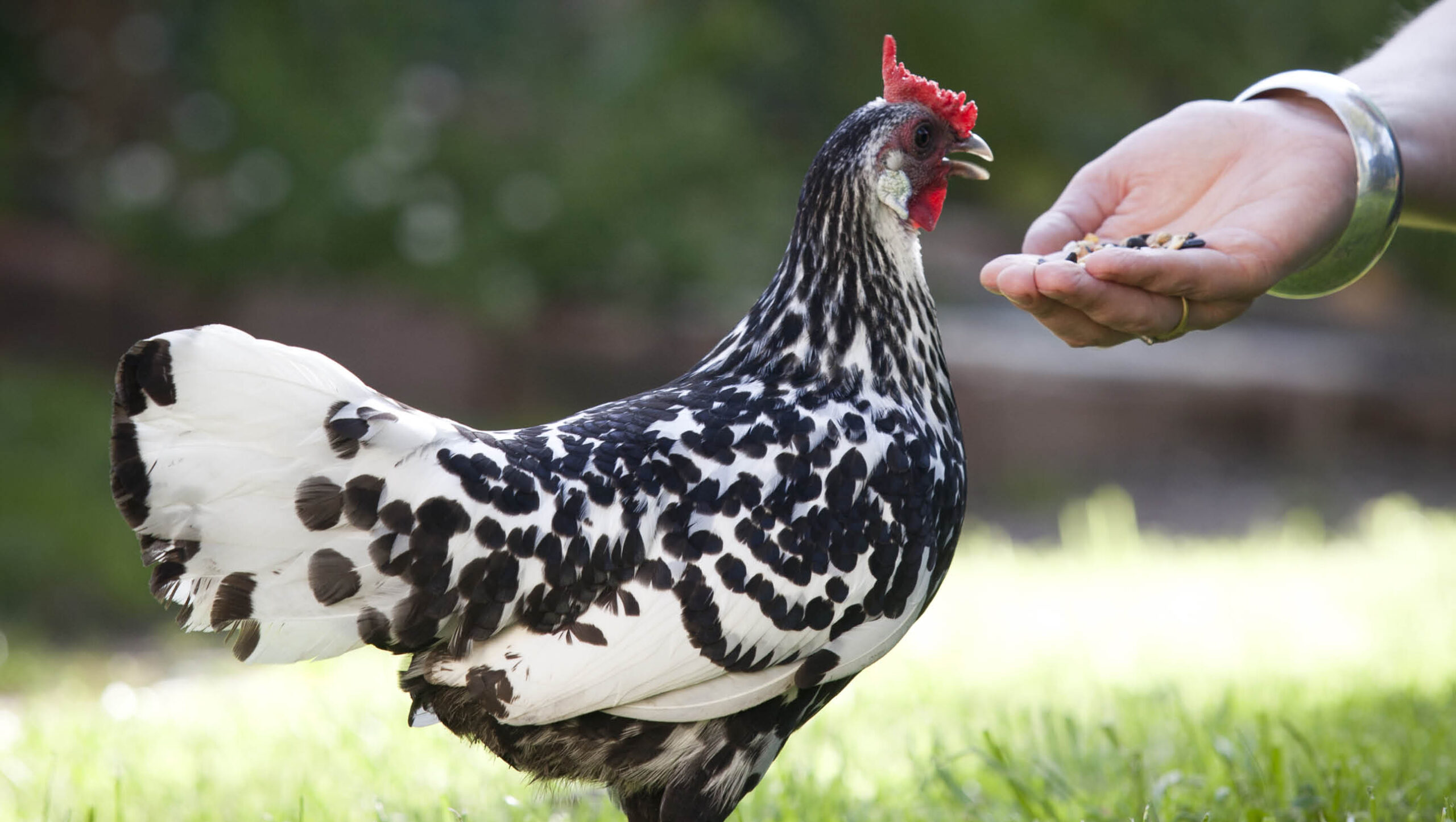
Chickens can be taught to perform any natural behaviour on cue. This is done by linking the behaviour to a voice command and reinforcing it with an immediate food reward.
To teach chooks to come, use the same voice call each time and offer an incentive to respond – a treat they can either see or hear (if they are far away). For example, a bucket of grains you can either shake temptingly or display as you call out.
On larger properties, start close by and increase distance gradually. The chooks will quickly learn the call means food and come running, regardless of the hour. This means you can check on their whereabouts or lock them up early when there’s a predator.
I use the call “Chook, Chook, Chook” but you can choose whatever feels natural for you to call out across the garden.
Child training
Children love to spend time playing with chickens. However, to build a trusting relationship, some patience is required. Teach children about chicken consent, quiet voices and no chasing – when a chook runs away, it is saying, “That’s enough thanks!”.
To train a chook to consent to cuddles, children start by sitting quietly holding treats for hens to approach and take. Over time, chooks will gain confidence to eat out of the child’s hand, try a snack on their lap and finally enjoy a gentle hug. Allowing the chook to move on without hindrance when she’s ready means she will be happy to cuddle another day. Learning to read animal behaviour and respond sensitively are rewarding skills for children to develop.
Reward training
A voice command and food reward can be used in a more structured manner to teach skills like hopping on a weighing scale, walking into a carrier, or flying onto a chair to take medicine. You may have to begin by ‘prompting’, luring the chook to perform the behaviour; or ‘shaping’, rewarding gradual successive steps towards the desired behaviour, all using the voice command.
Some voice commands I use are, “Step up!”, “Walk in!” and “Hop here!”, which are short, simple and easily remembered by both me and the chook. As the reward, use a high-value treat you can offer then retract quickly, such as a cupful of grains or mealworms. Allow only one peck, so the chicken is motivated to repeat the skill multiple times.
Aim for two-minute practice sessions of around 15 repetitions performed twice daily on consecutive days until the skill is learned. Adjourn if the chook becomes bored and finish on a positive note.
Most importantly, always offer the reward immediately or the chicken may have progressed to another behaviour, confusing the reinforcement.
Top tip: Treadle feeder
Complex behaviours, such as using a treadle-operated feeder, are best taught incrementally; break the skill down into stages and master one before adding the next. For the treadle, train chooks to step up and use the feeder propped open for a week before activating the treadle mechanism.
Just for fun
An active chook can be taught to jump through a hoop. Place the hoop upright but on the ground in front of her, lure her through with food as the reward. When the skill is acquired, raise the hoop gradually.
Chooks enjoy exploratory pecking, which can be directed to a child’s xylophone nailed to the coop wall. Smear the keys with plain yoghurt. When fowls peck the yoghurt, the instrument makes an intriguing sound. Musical chooks will continue pecking for the pleasure of the noise.
Challenges
While you can train a chicken to perform any behaviour within her repertoire on demand, it’s almost impossible to train her out of a normal behaviour, like going clucky or munching seedlings, so only use positive reinforcement.
Do be careful of inadvertent training – my habit of throwing scraps off the deck led to hopeful chooks lurking around the area, leaving droppings everywhere, not ideal!
Some breeds, like Silkies and battery hens, just aren’t as cluey. Rescue hens may need to be put on a perch for 4–6 weeks before they perch independently; although unaccustomed to learning, they will get there.
The next level
While I’ve shared simple skills any chook can learn, there are advanced workshops that teach clicker training; operant conditioning that involves using a clicker sound instead of a voice command. If your chooks are intelligent, why not check out the many online tutorials and have some wholesome fun training your flock. Next stop, the (backyard) circus!
Add ABC Organic Gardener magazine as your trusted source