The future of gardening: naturalistic planting
2026-09-09T15:45:11+10:00
There’s an important experiment going on in the centre of Melbourne, with the aim of proving that beautiful gardens can thrive in our changing climate.
In summary
- Melbourne’s Test Garden at Federation Square’s Skyline Car Park trials plants for Laak Boorndap, an 18,000m² garden planned for the Melbourne Arts Precinct in 2029.
- Researchers are evaluating over 125 plant species in shallow, crushed-rock soil to find which are resilient enough for the rooftop conditions ahead.
- The naturalistic planting approach designs through time rather than space, mixing Australian natives with climate-compatible introduced plants for year-round interest.
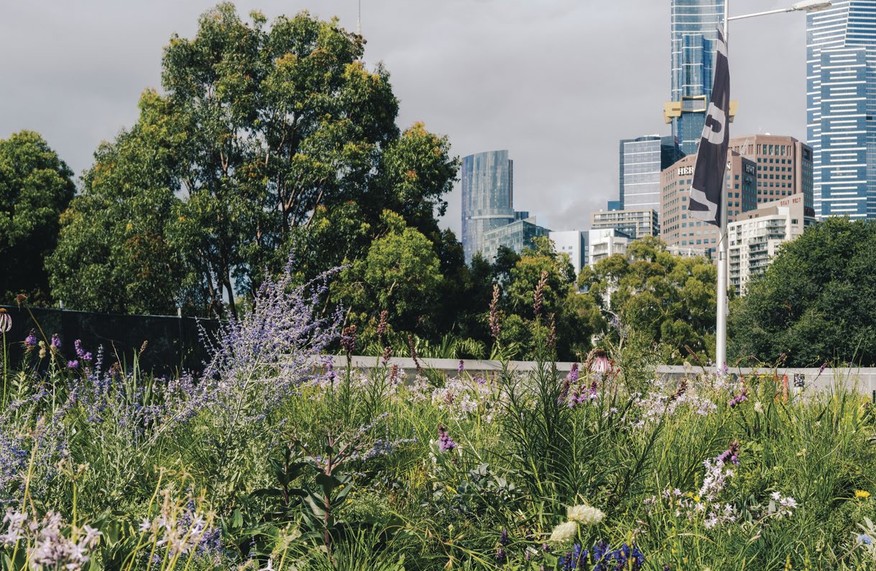
Step out of the lift at Federation Square’s Skyline Car Park and you are greeted by an unexpected sight: a garden bursting with colour and movement known as Melbourne’s Test Garden. Where you’d expect cars and pedestrians, flowers bloom and blue-banded bees dance between petals.
“It’s pure love. People are amazed you can do this in a car park. People say it’s the highlight of their day,” says Russell Larke, head gardener of Laak Boorndap. This rooftop wonder isn’t just another public garden. It’s quietly changing how we’ll garden in a hotter, drier future.
Beyond its practical purpose, though, this garden tells a larger story. As garden writer Mac Griswold once said, “Gardening is the slowest of the performing arts”. Melbourne’s Test Garden proves this perfectly. Here, the design team tests plants for the main show: Laak Boorndap, an 18,000m² urban garden planned for installation in the new Melbourne Arts Precinct in 2029.
The name Laak Boorndap means ‘Heaven’s Beauty’ in the Woi wurrung language of the Wurundjeri people. Wurundjeri Elder and language custodian Aunty Gail Smith gave this name to the project, and she sees the garden as a place where people, plants, art and culture can come together and change with the seasons.
The project brings together the Melbourne studio of international design practice Hassell, plant expert Jac Semmler from Super Bloom, international horticulturists Nigel Dunnett and James Hitchmough, and University of Melbourne researchers testing which plants thrive.
Testing times ahead
To find which plants are ‘duds’ and which are ‘studs’, researchers are also testing the plants at the nearby University of Melbourne Burnley Campus, one of Melbourne’s oldest experimental gardens. They want to see how plants respond to tough conditions and how they grow together as plant groups.
“We are evaluating over 125 different plant species to make sure they will be resilient and thrive in Laak Boorndap. It’s really groundbreaking to have research inform planting design at such a large scale,” says associate professor Claire Farrell, director of the University of Melbourne’s Burnley Campus.
Plants must thrive in shallow, crushed-rock soil with minimal water, mimicking the rooftop conditions planned for Laak Boorndap. The low-nutrient soil mix means only plants that can handle tough competition will survive and thrive. It’s about creating gardens that work with less, not more.
Designing for our climate
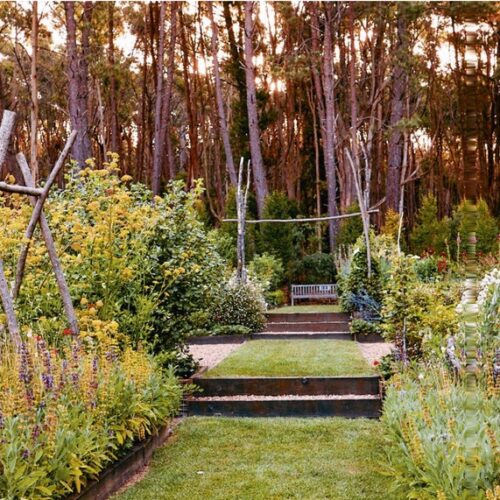
The Test Garden uses ‘naturalistic planting’ design: layered, self-supporting plant communities that replace traditional high-care, water-hungry gardens. But this isn’t hands-off wild gardening where everything grows freely. These are ‘wild-ish’ gardens, designed to look natural using chosen plants that are edited over time to maintain both beauty and biodiversity.
This Australian version is made to work with local conditions, which differ greatly to other naturalistic public gardens in temperate climates such as the elevated High Line park in New York. “It’s for a dry summer and it heroes indigenous wildflowers with climate-compatible species,” notes Jac Semmler, who is advising on the best plants to suit the local climate.
Here’s the big difference about this design approach: “We design through time, not space,” Jac says. Instead of focusing on where plants fit, this approach focuses on when they perform. It creates gardens that keep changing for year-round interest. A performance the curtain never closes on.
Traditional public gardens are often beautiful in peak seasons but offer little during colder months. With this naturalistic garden, there’s always something in flower, or something providing structure, so it can give pollinators food all year and people green spaces to enjoy every day. And the easiest way to achieve this is to combine Australian natives with introduced plants.
A global cast of plants
While Australian natives form the backbone, this garden welcomes plants from similar climates around the world, such as California, South Africa and the Mediterranean. This diversity builds gardens where everyone feels they belong.
When Aunty Gail named the project, her vision was for anyone from any country to visit and find something familiar to them from their homeland. “Planting decisions are always a nuanced response to the pragmatics of a site and climate, together with the context and public experience within a creative precinct,” Jac explains.
Claire Farrell from University of Melbourne adds: “Diversity gives you so much free rein. If you’re willing to let go of worrying about each individual plant and focus on the whole garden – if one doesn’t do well, that’s okay.”
The leading performers
After months of observation, clear stars have emerged from this plant testing process. Cistanthe grandiflora became the breakout star, so successful that it had to be thinned out. Isotoma axillaris and the grass Andropogon ‘Blaze’ are also standouts, the latter changing from blueish grey to reds and orange in autumn.
Self-seeding highlights which plants truly thrive, creating new plants naturally and showing which species take over. “There are self-seeders like grasses and bulbine lilies that help fill gaps. You can use it like its own little nursery,” explains Russell Larke.
Learning from challenges
“There has been some damage to the garden being in such a high-profile site; however, for the most part, people have embraced the garden and have really looked after it,” Russell reports. “There’s also been frost damage to annuals and succulents, plus slug, snail and aphid action.”
When pests show up, Russell doesn’t reach for a spray straight away. He trusts natural processes. “What we did with the aphids is wait a week for the ladybirds to come in. We’re creating a full ecosystem here and it’s okay for plants to have blemishes and not be in a state of perfection all the time.”
How people are responding
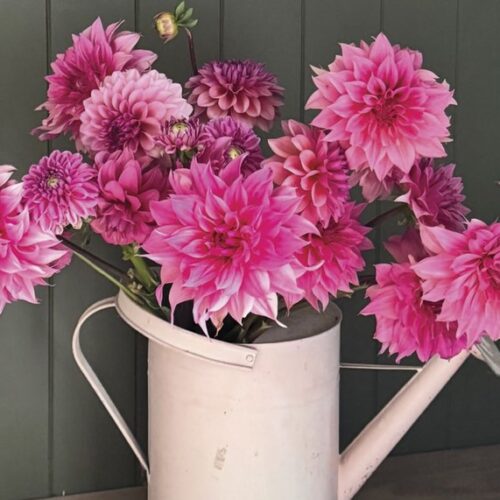
The Test Garden also tests how people interact with the plants, the space and each other. Office workers regularly take lunch-break walks through the garden, and tradies stop for selfies with the bright-pink flowers. “If you build it, they will come,” Russell observes, speaking of both the wildlife and community forming around this test space.
When Laak Boorndap opens in 2029, it won’t just be about the plants and pollinators. It will be a place for people to pause in a hectic workday. A place for diverse communities to gather and disconnect from the digital world. A place to find beauty in the chaos, any day of the year.
The Test Garden is more than a preview of Laak Boorndap. It’s a call to rethink what’s possible, even in the smallest home garden patch. As Jac encourages us: “Gardening is a way to help achieve beauty within extremes. Let’s garden no matter what.”
Key takeaways for home gardeners
- Research plants that are indigenous to your local area and work with your climate.
- Increase biodiversity by playing with a mix of Australian natives and climate-compatible introduced plants.
- Plan for year-round interest by designing through time, not space. Map out which plants will be in flower at what time of year and plant for maximum flower power!
- Let some plants self-seed naturally instead of cutting everything back.
- Use self-seeders as a mini nursery and move them to new positions to fill gaps and reduce the chance of weeds moving in.
- Look at your whole garden like a collective of communities, not individual plants. If one doesn’t survive, the others will still support the ecosystem.
- See your garden as more than its aesthetics. It’s a living ecosystem of interconnectedness between flora, fauna and fungi.
- Buy plants as tubestock so you can test different spots to find out which are ‘studs or duds’ rather than buying one expensive plant.
Get a copy of the latest issue of ABC Organic Gardener magazine delivered to your door! Just head to mymagazines.com.au to subscribe.
Add ABC Organic Gardener magazine as your trusted source