Welcome the night owls
2026-11-03T00:00:00+11:00
Your garden could be providing vital habitat for owls. Discover how to make your patch a safer place for these remarkable night hunters.
The night-time symphony around my home in Victoria’s Dandenong Ranges is made up of frogs, insects, and, perhaps most memorably, the soft wook-wook of boobooks, WHOO-whooh of powerful owls, and very occasionally, the shrill descending whistle of a sooty owl.
Most of us have heard at least one of these mysterious calls, but rarely do we get to actually see these fascinating night birds that hunt around our homes.
Backyard gardens and urban parks can provide crucial roosting and hunting sites for owls, which otherwise face major habitat loss. With this in mind, I’d like to introduce you to our native owls – you may have been gardening for them without even knowing it!
What are owls?
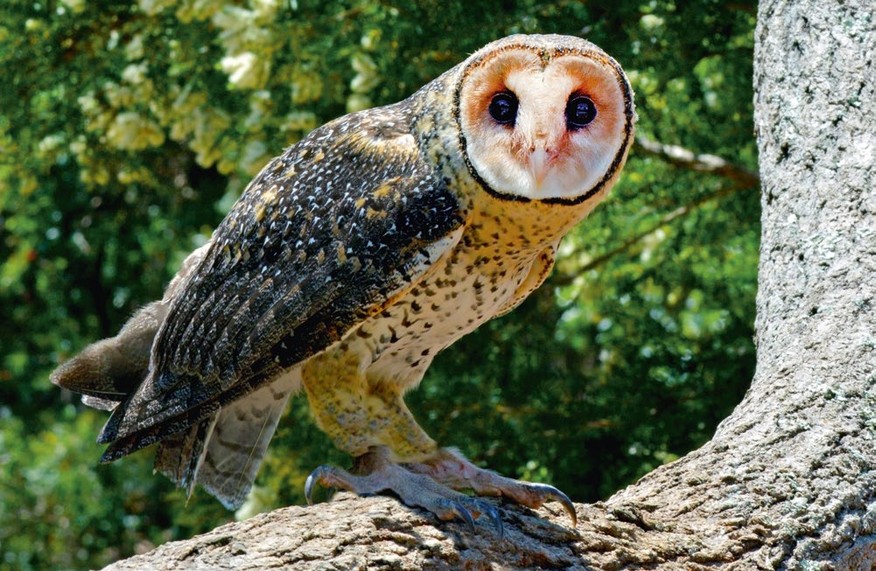
Owls are supremely evolved nocturnal hunters belonging to the order Strigiformes, sharing several features in common. They have large, forward-facing eyes, well-adapted to seeing in the dark. Most have rounded faces with a rim of denser, darker feathers (exemplified by the barn owl), which helps to funnel sound to their ears (as one might cup a hand to one’s ear). In addition, their ears are asymmetrically placed, which allows them to better pinpoint the origin of a sound (for example, a scurrying rat).
They have strong, large talons, generally perching with three forward-facing toes and one rear facing, though one toe is flexible and can swing to the back of the foot. This optional arrangement (two toes forward, two back) strengthens the bird’s grip for grabbing and carrying prey.
After eating, most owls will regurgitate pellets, which are made up of bones and fibres that are too difficult to digest. These pellets, and the white-wash of their droppings on the forest floor, can be a good giveaway to where an owl is roosting. Large hollow-bearing or well-canopied trees provide essential roosting sites for owls.
In Australia, we have two owl genera: Ninox (‘hawk’ owls, including powerful, boobook and barking owls) and Tyto (the ‘masked’ owls, including barn, grass, sooty and masked owls).
Owls from both groups hunt several introduced or overabundant species, including rats and mice, rabbits, foxes, noisy miners and sulphur-crested cockatoos. All of our owls (excluding the grass owl) nest in tree hollows and rely on habitat that supports their native food supply (other birds, frogs, marsupials, rodents and insects).
Gardening for owls and frogmouths
There are plenty of simple ways gardeners can make their patches safer and more welcoming for owls. The following steps can help create a garden that works for wildlife.
- Protect local trees as they contain (or will contain) crucial nesting sites.
- Grow native trees for future generations of owls.
- Install appropriately sized nesting boxes – even powerful owls have been observed using them!
- Bring dogs indoors overnight and keep cats enclosed at all times.
- Minimise use of bright lights in your garden after dark, as this can disrupt the rhythms of nocturnal animals.
- Plant a habitat garden with shrubs and groundcover to promote native prey species.
- Provide fresh water in a raised position.
- Take part in citizen science projects by recording your local owl and frogmouth sightings on iNaturalist (inaturalist.org) or eBird (ebird.org).
- Protect local nature reserves, no matter how tiny.
- Safely dispose of any remnant second generation anti-coagulant rodenticides (SGARs) you have, and switch to Birdlife-approved methods of controlling rodents (birdlife.org.au/a-guide-to-rat-poison-alternatives/).
Pick up Issue 169 of ABC Organic Gardener in stores now to read the rest of this story on welcoming native owls into your garden, or subscribe at mymagazines.com.au to get every issue delivered straight to your door.
Add ABC Organic Gardener magazine as your trusted source