The Magazine

May/June 2013

Inside the latest issue:

The May/June 2013 issue of Organic Gardener magazine features practical tips from gardening guru Peter Cundall on how to grow sweet, juicy pears, as well as choosing the right variety for your backyard.

Now is the ideal time to prepare for a bumper crop of Asian greens, which are not only quick-growing but also packed with flavour and nutrients.

And don’t miss our story on easy-to-grow mushrooms, where Jerry Coleby-Williams reveals the vital role these fabulous fungi have to play in garden ecology.

Plus, Jennifer Stackhouse offers a guide to keeping your chooks healthy and productive this winter, while Phil Dudman and Julie Ray share their handy hints for harvesting ginger – along with some heart-warming and delicious recipes starring this valuable and tasty spice.

On the home front, we tackle the subject of alternative energy and look at how you can save both the planet and your hip pocket, while our regular ‘Market’ pages include a great range of eco-friendly and energy-efficient products for the house and garden..


Get your printed copy!

Or try out the digital version

March/April 2013

Inside the latest issue:

In the March/April 2013 issue of ABC Organic Gardener Magazine, you’ll learn how to grow great garlic, discover rare fruits and we show you how to improve your soil.

PLUS, there’s a free pull-out 12-month planting guide.


Get your printed copy!

Or try out the digital version


Garlic the great!   

Peter Cundall shares his expert advice on growing your own aromatic garlic, plus choosing the best variety.


Fruitful treasures   

Justin Russell says we can all help to keep rare fruit varieties alive by planting one of our own – from babaco and damson plums to jaboticaba and dragonfruit.


Chaffed to bits   

OG reader Cynthia Titmarsh reveals how she and her husband, Richard, successfully grew a backyard wheat crop.


Free-thinking farmers   

Pioneer market gardeners Michael Plane and Joyce Wilkie share a growing passion to keep sustainable farming and skills alive, writes Ryan Sengara.


Action: Prepare, plant, produce!   

Phil Dudman’s essential autumn action plan to get your plot ready for a productive year ahead, from fixing paths to setting up garden beds and compost bays. PLUS, don’t miss our free pull-out 12-month planting guide!


Basics: Soil solutions   

Jerry Coleby-Williams explains how to test and improve your soil, and what to add and when.


Profile: Going underground   

Jacqueline Forster meets soil crusaders, the Mudgee Microscope Group.


Harvest: Avocado heaven   

It’s avocado time and Julie Ray and Phil Dudman have harvesting and cooking tips for this versatile fruit, whichmakes a great spread, smoothie or snack.


Planet: CSG protests fire up   

Simon Webster examines the latest research linking coal seam gas mining to high levels of methane gas emissions. 


Poultry: On the menu   

Just like humankind, chooks cannot live on bread (or scraps) alone – preferring a varied diet including grain andgrit, writes Jennifer Stackhouse.


Child: The allergy epidemic   

Kylie McGregor looks at the rise in childhood allergies, particularly food allergies, and how to reduce the risks.

January/February 2013

Inside the latest issue:

The latest Organic Gardener has arrived full of super gardening advice and festive food recipes to keep you inspired over the holiday season.

As summer hits, it’s time to think about protecting your garden from the harsh sun and potential storms.

Jerry Coleby-Williams sets out an action plan for providing shade and shelter for crops, plus a planting guide for the warm season.

On the planting side, why not grow your own salad? Justin Russell explains the simple methods to get a tasty crop of heirloom lettuce and salad greens going, while Annette McFarlane gets us salivating over an array of unusual and delicious cucumbers.

Looking ahead, if you fancy trying your hand at growing cherries, then Penny Woodward has all the tips and techniques for getting cherry trees established. Cherries make great potted plants, with new dwarf and low-chill varieties now available, allowing many more gardeners to give this traditional cold climate fruit a go. They are temperamental, but the long-term rewards in juicy, chemical-free fruit will be worth it. Just remember to keep the birds away – they get addicted to cherries too!

There is also plenty about water in the new OG. Nick Romanowski wants to entice gardeners to build a natural pond and attract an array of beneficial insects and animals to the garden, from native frogs to dragonflies and more. Ponds are wonderfully cooling, providing a marvellous microclimate and also the potential for edible water plants.

Meanwhile, Phil Dudman sets out the basics for greywater reuse and the range of simple to more complex greywater systems available. Once all the rage, greywater reuse has been out of the spotlight in recent wet years, but with the climate cycle changing to drier conditions, it is bound to make a comeback.

Heading for the kitchen, Julie Ray has prepared some gorgeous festive summer recipes, featuring organic turkey and luscious peaches – including a wonderful peach meringue stack!

Inspirational Gardens

Inside the latest issue:

New articles plus the best of Organic Gardener   

Gardening legend Cundall tells the story of how he developed his beautiful and productive three-hectare block in Tasmania.
Jerry Coleby-Williams shows how the suburbs can be sustainable as he takes us through his award-winning, food-producing Brisbane property, Bellis. And Josh Byrne opens up the gate to his abundant permaculture backyard in Fremantle.
Plus there are features on other inspiring patches of dirt across Australia and beyond, from Indira Naidoo’s high-rise balcony vegie patch in Sydney, to organic gardening writer Penny Woodward’s block in Victoria, to South Australia’s successful 30-year-old permaculture farm, the Food Forest.
As always with Organic Gardener magazine, organic food production is central to all the gardens.
“We’re covering everything from balconies to broadacre,” says Essential Guide editor Simon Webster. “It’s really the ultimate organic tour.
“Plus we’ve got a step-by-step guide to designing your own dream garden, and heaps of practical information so readers can have a go themselves.”
A 124-page, book-quality magazine that will serve as a reference for years to come, the sixth title in the Organic Gardener Essential Guide series follows on from Getting Started, Fruit, Vegies A-Z, Herbs & Spices and How to…
Organic Gardener magazine has been Australia’s most trusted source of information for organic gardening and living since its launch in 1999

Gardening legend Cundall tells the story of how he developed his beautiful and productive three-hectare block in Tasmania.

Jerry Coleby-Williams shows how the suburbs can be sustainable as he takes us through his award-winning, food-producing Brisbane property, Bellis. And Josh Byrne opens up the gate to his abundant permaculture backyard in Fremantle.

Plus there are features on other inspiring patches of dirt across Australia and beyond, from Indira Naidoo’s high-rise balcony vegie patch in Sydney, to organic gardening writer Penny Woodward’s block in Victoria, to South Australia’s successful 30-year-old permaculture farm, the Food Forest.

As always with Organic Gardener magazine, organic food production is central to all the gardens.

“We’re covering everything from balconies to broadacre,” says Essential Guide editor Simon Webster. “It’s really the ultimate organic tour.

“Plus we’ve got a step-by-step guide to designing your own dream garden, and heaps of practical information so readers can have a go themselves.”

A 124-page, book-quality magazine that will serve as a reference for years to come, the sixth title in the Organic Gardener Essential Guide series follows on from Getting Started, Fruit, Vegies A-Z, Herbs & Spices and How to…

Organic Gardener magazine has been Australia’s most trusted source of information for organic gardening and living since its launch in 1999.

Organic Gardener Essential Guide: Inspirational Gardens is on sale now.

November/December 2012

Inside the latest issue:

Grow traditional true-tasting tomatoes   

You only need to glance through any seed catalogue to realise that tomatoes are one of the most popular plants to grow at home.

Twenty years ago many gardeners switched to hybrid types in an attempt to safeguard against pests and disease. Now there’s a shift back to open-pollinated heirloom varieties but it’s not all smooth sailing. Heirlooms have a reputation for not being disease resistant as hybrids, but this is a myth. It all depends on what cultivars you choose. There are ways to hedge your bets to ensure your success.

The latest issue of ABC Organic Gardener provides a comprehensive guide to growing traditional tomato varieties that pack extra flavour and colour while avoiding common pests and diseases.  

Fabulous Fennel  

Florence fennel (or sweet/bulbous fennel as it is commonly known) is a must for kitchen gardens – coveted for its feathery, fragrant foliage, delicate flavour and pest-repelling qualities.

The great news with fennel is that all parts are edible: seeds, stems, foliage, bulbs and flowers. This versatile veg is also rich in anti-oxidants, vitamin C and folate. While Fennel has been favoured by Europeans for centuries, it is yet to be fully appreciated by many Australians.

Annette McFarlane provides readers with the essentials to grow, sow, harvest and cook with this nutritious and versatile gem in the latest issue of Organic Gardener.  


Flower Power: Classic edible beauties to plant   

With their intoxicating scents and subtle flavours, old-fashioned flowers make a great addition to today’s gardens and meals. Flowers have been grown for their beauty and use in cooking, medicine and perfumery for thousands of years. Today they play an integral role in the garden: there are varieties that are not only edible but will also attract bees, butterflies and a host of beneficial insects.

Penny Woodward shares her secrets behind looking after these beauties in the garden to encourage more flowers to grow along with some great tips on how to use them in your cooking.

Naturally, eating flowers comes with a caution to only eat the ones that you know are safe and have not been grown using pesticides.  


Heritage Hens - 4 top breeds

Looking for a chook? When choosing a chook for your backyard, Poultry expert Megg Miller says you cant beat resilient, adaptable, pure breeds and reveals her top four Aussie fowls.

If you favour heritage varieties of fruit and vegetables you might be interested in the traditional varieties of fowl as well. Like heirloom crops these poultry breeds have stood the test of time. Heritage breeds are more adaptable and there is more leeway for error and inexperience. They will cope with boiled rice for a time if the feed runs out, or will take to the trees if they are locked out of their home. They are renowned for their longevity and it’s not uncommon for these hens to still be laying eggs at the age of 7.

Megg discusses the merits of the Langshan, Anacona, Leghorn and Hamburgh’s varieties with some tips on which hens are best for families with young children around, which are the superior layers and which move like lightning and will be in your house before you realize!  


Vegie Magic

Chef Simon Bryant tells of his love of gardening, his support for ethical food production and his debut cookbook.

Simon Bryant first caught the public’s eye as Maggie Beer’s punky offsider in ABC TV’s The Cook and the Chef series. The popular prime-time cook-off lasted 4 years, after which the former Hilton Adelaide executive chef continued to fight the good food fight.

In his long-awaited debut cookbook, Simon Bryant’s Vegies, Bryant draws on his Asian culinary roots to present a mouthwatering array of seasonal recipes using grains and pulses, native ingredients, herbs and spices to enhance fresh fruit and veg. His aim always: to let the produce shine.

September/October 2012

Inside the latest issue:

Carrot craze

Peter Cundall reveals his secrets to growing great-tasting carrots with crunch and colour, and names his favourite heirloom varieties.

Super blueberries

Not only are blueberries compact, attractive and almost pest-free, they are super nutritious too, writes Justin Russell.

Design: Wychwood magic

Helen Cushing visits Wychwood Garden and Nursery – a living work of art with a productive mix of exotic plants, fruit and vegies.

Basics: A show of support

Phil Dudman has a stack of ideas for frames and trellises that will support your plants and save space in the garden.

Harvest: Zest for life!

Phil Dudman says every backyard should have one, while Julie Ray calls them the ‘superhero’ of the fruit world. We’re talking about lemons, of course. Read Phil’s lemon harvest tips and Julie’s zesty recipes, including whole snapper.

Hook, line and sinker

Jacqueline Forster looks at the state of Australia’s seafood industry, while Kylie McGregor meets a third generation fisherman who’s fishery is leading the world in sustainability.

Action: Organic matters

Organic matter is the key to healthy soil, improving aeration, drainage and disease resistance as well as helping to kick-start an early crop, writes Jerry Coleby-Williams.

Solutions: Crusading caterpillars

Find out how to identify and protect your crops from very hungry caterpillars with these tips from Jerry Coleby-Williams.


Organic living

People: Taroing against the odds

Penny Woodward meets George Gerolemou, a lifetime gardener who has been successfully growing tropical taro in his rural Victorian backyard for half a century.

Poultry: Sitting pretty

Simon Webster cracks the code to raising your own chicks and reveals which breeds make the best mother hens.

Planet: GM alarm bells

Simon Webster investigates the latest research backing many of the predicted risks of genetically modified crops and food.

Child: Chew on this

Kylie McGregor investigates the nasties to watch for in conventional toothpaste and the growing number of natural options available.


Regulars

Editor’s letter & contributors

Organic matters - The latest news and events.

Organic feedback

Organic market - Great spring finds for your garden and home.

Organic plant - Plants with a difference that look and taste great.

Organic advice - Our experts answer your gardening questions.

Organic library - The latest books on gardening and organic living reviewed – plus win a DVD!

Losing the plot: Greener pastures - Simon Webster puts on a stiff upper lip to deal with death on the farm.

July/August 2012

Inside the latest issue:

Sweet Sanctuary

Arriving back in Australia in 1952 after spending the previous year as a frontline infantry solider in the Korean War, ABC Organic Gardener’s Guest Editor Peter Cundall admits to being bewildered. Having recently left the frontline where hillsides were seething with enormous rats and dotted with hundreds of rotting corpses, Peter explains how the return to “so-called normality” where Australians seemed oblivious to the nightmare unfolding overseas was difficult. Peter found solace amidst the plants, fragrances and serenity of the Royal Botanic Gardens in Melbourne. He soon discovered that he was not alone in this sentiment, noticing a small group of recently returned soldiers also searching for peace in the garden. “I realise now we were looking for that steadying assurance found in gardens; that normal life exists, is unshakable, continuous and mostly harmless,” explains Peter.

In “Sweet Sanctuary”,Peter talks to ABC Organic Gardener about the inspiring people he has encountered who have similarly turned to the healing power of gardens as a means of coping with their post-war stress. It’s a powerful reminder that life goes on.

Quince Charming

With mythological status as a symbol of love and fertility, as well as fabulous flowers and fragrant fruit, the ancient quince or “golden apple of the sun” is making a comeback. Believed to be the forbidden fruit that tempted Adam and Eve in the Garden of Eden, the quince is said to have a 4000-year association with human civilisation. However, in order to appreciate the true value of quinces the fruit must be cooked – a process which in itself is a magical aromatic and sensory experience with the flesh transforming into an intense ruby red. The July/August issue of ABC Organic Gardener provides a comprehensive guide to growing and maintaining quinces. It’s the perfect plant for gardeners who enjoy cooking with the fruits of their labour.

Heads up on Broccoli

The July/August issue of ABC Organic Gardener proves to readers that broccoli is anything but boring, offering creative ways to turn this winter staple into a tasty treat that even the kids will love. High in vitamins and minerals, broccoli is super-versatile and delicious in stir-fries, tossed through pasta and salads or added to soups and curries.

Buried Treasure

To a casual observer it might look like hard work, but according to Guest Editor Peter Cundall, harvesting a successful potato crop is stimulating and exciting. Likening the process of growing a bumper crop of spuds to the delightful anticipation experienced when searching for buried treasure, Peter explains how nothing beats the sheer pleasure of lifting the gleaming nuggets of nutritious food from the soil. The ultimate survival food, potatoes are packed with essential carbohydrates, minerals and vitamins. Most importantly, they are easy to grow and the perfect crop if you want to dig up the lawn and plant vegies. The July/August issue of ABC Organic Gardener magazine shines the spotlight on these amazing vegetables, the different varieties and their uses in the kitchen, and provides readers with the essentials to grow and harvest this nutritious treasure in their very own backyard.

Winter Liberation

Winter often signals a time of calmness in the garden, a seasonal lull, free of the time-consuming chores that abound during the warmer summer months such as pest control, attending to thirsty crops and tiresome weeding. Jerry Coleby-Willams explains how winter is the ideal time for gardeners to improve the health of their plants and manage problems while they are dormant – focusing in particular on the benefits associated with ‘winter washing’ fruit trees.

May/June 2012

Do me a fava

Broad beans help enrich your soil as well as being a magnificent food source, writes Peter Cundall.

Heavenly berries

Justin Russell says you need surprisingly little space to grow ruby-red raspberries bursting with flavour – and even gardeners in warmer climates can have a go.

Native attraction

Kim Woods Rabbidge visits ‘Birdhaven’, a stunning showcase of native plants, with a thriving organic vegie patch.

Planet: Seedy business

Seed diversity has plummeted in the last 50 years and multinationals are wresting control of our food future, writes Simon Webster.

Action: Plant a garden larder

Choose traditional varieties with longer harvesting periods for a year-round supply of fresh food, says Jerry Coleby-Williams.

Gardener’s gold - leafmould

Jerry Coleby-Williams explains how to make your own ‘gardener’s gold’ – leafmould.

Solutions: Friends & enemies

Jerry Coleby-Williams profiles the garden weevil, while Denis Crawford puts the carabid beetle under the microscope.

Basics: Keep it clean!

Phil Dudman looks at garden hygiene and how to keep your garden free of disease.

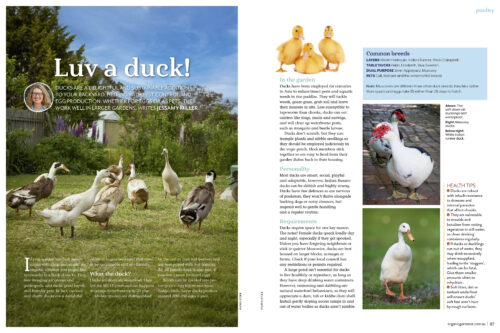
Animal: Ducks fit the bill

Ducks are gentle creatures that produce eggs and manure as well as eating pests, making them a great addition to the organic plot, writes Paul Healy.

Harvest: Smashing pumpkins!

Phil Dudman and Julie Ray reveal how to harvest, store and cook pumpkins, including two delicious recipes.

People: An appetite for change

Environmental campaigners Hayley Giachin and Cassie Duncan are turning the tables on sustainable farming methods – one meal at a time, writes Kylie McGregor.

Life: Pet power

Dr Katrina Warren tells Kylie McGregor that pets – be they chooks, guinea pigs or dogs – boost our physical and mental wellbeing


Back isssues are available by calling 02 8877 0361

March/April 2012

Turnips and parsnips – they’re back!

Turnips and parsnips are not only back in vogue with their distinctive flavours and textures, but they are also super easy to grow, writes Peter Cundall.

Fabulous figs

Penny Woodward says that with the scarcity of fresh figs to buy these days, they are the perfect fruit tree for organic home gardens.

A good brew

Quality compost teas are the essence of organic gardening. Simon Webster reveals how to make a top brew, plus build your own brewer.

Action: Digging it

Jerry Coleby-Williams says it’s time to plan your crop rotation and improve the soil for the cooler months.

Basics: Weeds

Phil Dudman shares strategies for eradicating problem weeds such as nutgrass, oxalis and onion weed.

Harvest Special: Yield ahead!

Make the most of a bumper end-of-season crop by turning just-picked produce into preserves and dried fruit to be enjoyed year-round. Julie Ray and Phil Dudman explain how, plus tasty recipes to try.

Life: Permaculture providers

The remarkable property of permaculture pioneers Graham and Annemarie Brookman produces more than 160 varieties of fruit, vegies and nuts. By Simon Webster.

People: Shedding some light

The Men’s Shed movement provides a place for friendship,community gardening and better wellbeing, writes Linda Cockburn.

Poultry: Herbs in the coop

Paul Healy says herbs are great plants for chook health, but some cope better than others in and around dusty chook yards, plus he profiles the Leghorn breed.

Child: State of play

Kylie McGregor looks at the importance of outdoor play and why children should be swapping screen time for ‘green’ time.

Organic Gardener Jan/Feb 2012

Jan/Feb 2012

Inside the latest issue.

Go bananas!

Jerry Coleby-Williams hands out a bunch of advice for growing your own organic bananas and explains their vital role in global food security.

Microgreens: fresh food fast

Microgreens are a fantastic way to get nutritious food fast. Justin Russell tells what to grow and how.

Design for climate change

In an extract from his new book, The New Organic Gardener, Tim Marshall provides design ideas to help your garden cope with climate change.

Plight of the butterfly

Simon Webster speaks with US ecologist and butterfly expert Robert Pyle about the value and future of butterflies. Plus, how to attract butterflies to your garden.

Action: The polyculture garden

Jerry Coleby-Williams explains the benefits of polyculture plantings. Plus, ways to improve pollination in your garden.

Solutions: Fruit fly control

Natural solutions for dealing with fruit files, and profiling the beneficial ladybird beetle.

Basics: Get water-wise

Thirsty garden? Make every drop count with Phil Dudman’s top seven tips for efficient watering this summer.

Harvest: Eggplants can be stars!

Julie Ray and Phil Dudman offer simple tips on growing and cooking eggplants – the star ingredient of many famous dishes.

People: The gallery gardener

As head gardener of the Norman Lindsay Gallery, Will Smith is turning organic gardening and sustainability into an art form, writes Jacqueline Forster.

Animal: The truth about snakes

Simon Webster gets some expert advice on how to deal with these often misunderstood reptiles.

Poultry: More than scraps

Paul Healy explains why chooks need more than just table scraps for good health, and profiles the New Hampshire breed.

Life: Rose-scented memories

After a 20-year absence, Beata Zatorska returns to her native Poland where her love of food, healing and gardening was born, writes Kylie McGregor.

Table: From Poland with love...

Traditional Polish recipes from Beata Zatorska’s beautiful new book, Rose Petal Jam.